Hair Restoration
Hair Loss Treatment in Bend & Redmond: What Actually Works
Hair loss is common, treatable, and often reversible — but only when the cause is correctly identified. This guide explains how a dermatologist diagnoses hair loss and the real options available in Bend and Redmond, from prescriptions and PRP to the Folix® laser.
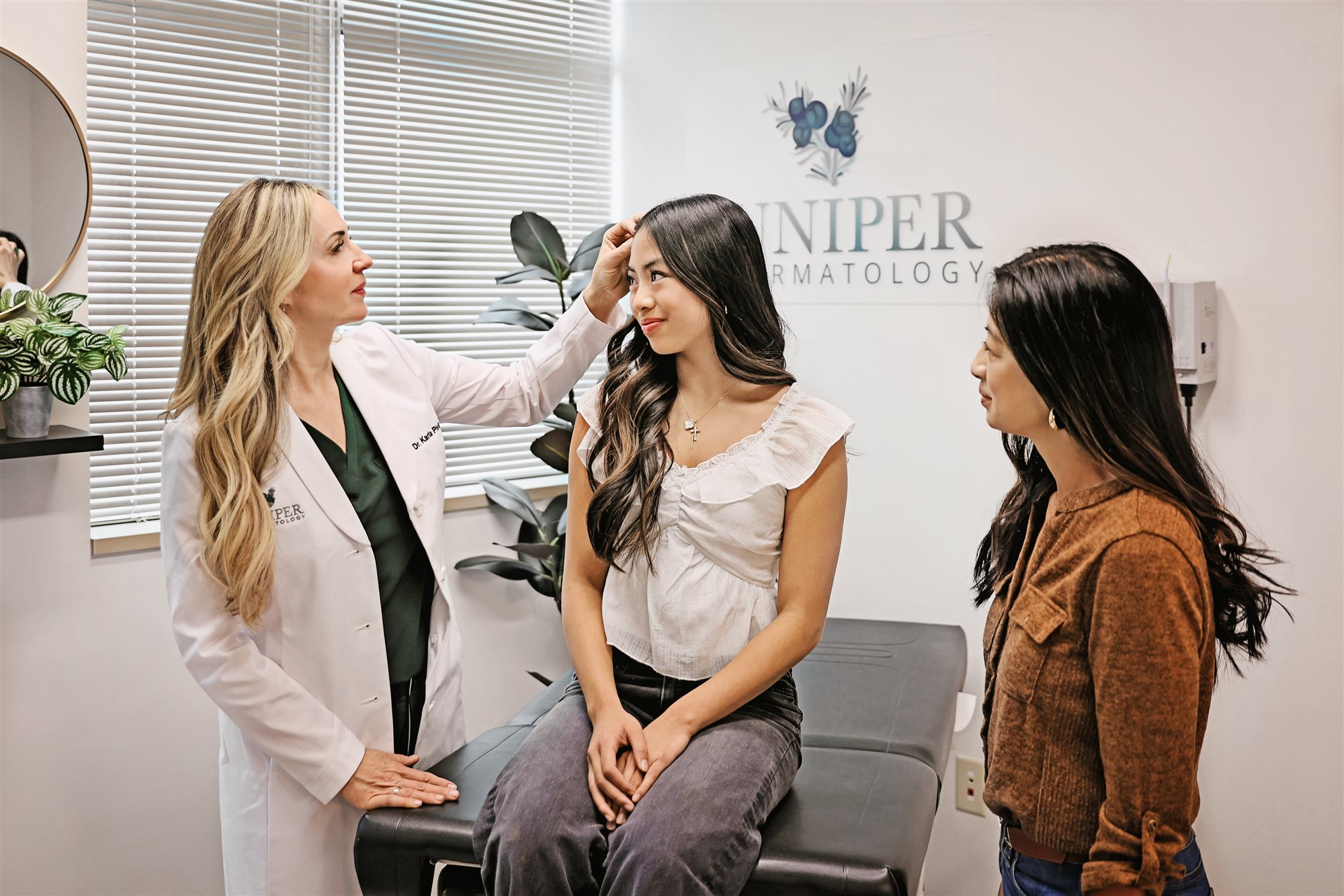
Losing your hair can feel deeply personal, and the internet is full of products promising to fix it. The most important thing to understand is this: hair loss has many different causes, and the right treatment depends entirely on the cause. That is why a dermatologist’s first job is not to prescribe — it is to diagnose.
Some hair loss is genetic and gradual. Some is triggered by stress, illness, pregnancy, thyroid problems, iron deficiency, or medication. Some is caused by inflammation that can scar the follicle if it is not treated in time. Getting the diagnosis right is what separates effective treatment from wasted time and money.
Why diagnosis comes first
A dermatologist evaluates hair loss with a focused history, an examination of the scalp and hair (often with magnification), and sometimes bloodwork or a small scalp biopsy. The goal is to identify the pattern and cause:
- Androgenetic alopecia (male- and female-pattern hair loss) — the most common type, gradual and often responsive to treatment.
- Telogen effluvium — temporary shedding after stress, illness, childbirth, or a nutritional trigger; often reversible once the trigger resolves.
- Alopecia areata — patchy, autoimmune hair loss that can respond to medical therapy.
- Scarring (cicatricial) alopecias — inflammation that can permanently damage follicles, making early diagnosis genuinely time-sensitive.
- Nutritional or hormonal causes — iron, thyroid, and other imbalances that show up in the hair.
The time-sensitive kind
Scarring alopecias can cause permanent follicle loss if inflammation goes untreated. Redness, scaling, burning, or itching along with hair loss deserves a prompt dermatology evaluation.
Treatments that have real evidence
Prescription and topical therapies
For pattern hair loss, the best-studied treatments include topical minoxidil and, for appropriate patients, oral prescription options such as finasteride (and, increasingly, low-dose oral minoxidil under medical supervision). These work best when started earlier and used consistently, and a dermatologist can match the therapy to your health history and monitor it over time.
PRP (platelet-rich plasma)
PRP uses growth factors concentrated from a small sample of your own blood, injected into the scalp to help support existing follicles. Evidence suggests it can be a helpful part of a plan for certain types of hair loss, typically as a series of sessions with periodic maintenance. It is most effective as one piece of a diagnosis-driven strategy — not a stand-alone miracle.
The Folix® laser
Folix® is an FDA-cleared fractional laser indicated for hair loss in women and men. Low-level and fractional laser (light) therapies aim to stimulate the follicle and support regrowth. Juniper offers the Folix® laser at its Bend office — it is the only one of its kind currently available in Central Oregon — as one option within a broader, individualized plan.
Supplements and supportive care
Correcting a genuine deficiency (such as iron) can meaningfully help, and targeted nutritional support has a role for some patients. But supplements are not a substitute for diagnosis, and “more” is not always better — some supplements taken in excess can worsen shedding. A dermatologist can tell you which, if any, are worth your money.
Combining treatments for better results
For many patients, the most effective approach layers several evidence-based treatments — for example, a topical or oral medication plus PRP and/or laser, chosen for the specific diagnosis. Because hair grows slowly, results take months, and consistent follow-up matters. Photographs at each visit help track real progress objectively.
What to expect at a hair-loss consultation
At Juniper’s hair restoration program, a visit begins with diagnosis: your history, a scalp and hair exam, and labs if indicated. From there, your dermatologist builds a plan from the options above and sets realistic expectations for the timeline. Medical hair-loss evaluations may be billable to insurance when they are for a medical diagnosis; cosmetic treatments generally are not. We see hair-loss patients in both Bend and Redmond, with Folix® laser treatments performed in Bend.
If your hair has been shedding, thinning, or changing, an evaluation is the right first step - the earlier the diagnosis, the more options you tend to have. You can request an appointment or read more about hair restoration for women and men.
Frequently asked questions
Does PRP work for hair loss?
For appropriate types of hair loss, PRP (platelet-rich plasma) can be a helpful part of a treatment plan. It uses growth factors from your own blood to support existing follicles and is typically done as a series of sessions with maintenance. It works best alongside an accurate diagnosis and other evidence-based therapies rather than on its own.
What is the Folix® laser, and where can I get it in Central Oregon?
Folix® is an FDA-cleared fractional laser indicated for hair loss in women and men. Juniper Dermatology offers it at the Bend office — currently the only one of its kind in Central Oregon — as one option within an individualized hair-loss plan.
Is hair loss reversible?
It depends on the cause. Many types — such as temporary shedding (telogen effluvium) and early pattern hair loss — respond well to treatment. Scarring alopecias, however, can cause permanent follicle loss, which is why an early, accurate diagnosis is so important.
Will insurance cover hair loss treatment?
A medical hair-loss evaluation may be billed to insurance when it is for a medical diagnosis, but coverage varies by plan and many cosmetic treatments are not covered. The practice can help verify your benefits before treatment.
Sources & further reading
This article is patient-education information reviewed by a board-certified dermatologist. It is general information, not medical advice, and is not a substitute for an in-person evaluation. For concerns about your skin or hair, please see a qualified clinician.