Unwanted tattoos
Progressive fading of professional and amateur ink.
Tattoo Removal · Bend
Precise, wavelength-tuned fading of unwanted ink — session by session, with your skin protected throughout.

Before & after
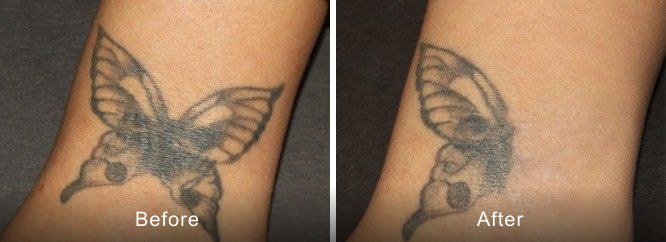
Representative clinical results from the device manufacturer. Individual results vary; your plan is tailored during your visit.
Part of Juniper’s Bend Laser Center
See how resurfacing, vascular, pigment, tattoo, hair-reduction, and related energy treatments differ in targets, downtime, and skin-tone considerations. Treatments are performed at our Bend flagship; we welcome patients from Redmond and across Central Oregon.
Overview
Laser tattoo removal uses rapid pulses of light to shatter tattoo ink into tiny particles your body then clears naturally. Different ink colors absorb different wavelengths, so the right laser settings make all the difference.
Over a series of sessions, tattoos fade progressively. Because the skin over a tattoo needs careful handling, dermatologist oversight helps protect against scarring and pigment change.
A closer look
The laser sends rapid, high-energy pulses that shatter tattoo ink into particles small enough for your immune system to carry away over the weeks between sessions. Different ink colors absorb different wavelengths, so effective removal depends on using the right wavelength for each color — which is why a single-color device leaves stubborn ink behind.
Modern picosecond lasers (the category that includes PicoSure and PicoWay) deliver energy in ultra-short pulses that break ink more efficiently and can be gentler on surrounding skin than older nanosecond lasers — often meaning better clearance in fewer sessions.
Most tattoos need multiple sessions spaced several weeks apart to let your body clear the fragmented ink between visits. The number depends on the ink colors, how deep and dense the tattoo is, its age, its location on the body, and your skin — professional tattoos generally take more sessions than amateur ones.
Rushing doesn’t help; spacing sessions properly protects your skin and improves clearance. Your dermatologist gives you a realistic estimate after seeing the tattoo. Individual results vary.
Tattoo removal is a laser-on-skin procedure with real risks of blistering, scarring, and permanent pigment change if energy and wavelength aren’t matched to your ink and skin tone. A board-certified dermatologist chooses settings to clear ink while protecting the skin — and manages any reaction on the spot.
That matters most for deeper skin tones and for colored ink, where the margin between effective and harmful settings is narrowest. It’s the difference between fading a tattoo and trading it for a scar.
What to expect
After each session expect redness, swelling, and sometimes blistering or scabbing over the treated ink - a normal part of how the body clears the shattered pigment. Keep it protected while it heals.
Tattoos fade progressively across a series; the number of sessions depends on ink colors, depth, and age of the tattoo, which we'll assess up front.
What it treats
Progressive fading of professional and amateur ink.
Lightening of aged tattoos for removal or cover-up.
Wavelength-tuned targeting of different ink colors.
Why patients choose it
Settings tuned to your specific ink and skin.
Dermatologist oversight guards against scarring.
Steady fading across a planned series.
Investment & financing
Tattoo removal is priced per session and by tattoo size, and most tattoos need several sessions to clear fully. We'll estimate the likely course at your visit so you know what to expect from the start.
Exact pricing is personalized to your plan and confirmed at your visit. We accept major cards and offer CareCredit financing.
Why a dermatologist
Tattoo removal can scar or lighten skin if done carelessly. A dermatologist manages settings and skin response — prioritizing your skin's health, not just ink clearance.
Call or text 541-585-7546Common questions
Most tattoos need multiple sessions spaced several weeks apart. The number depends on ink colors, depth, age, and your skin — we give you a realistic estimate at your visit.
Patients describe a snapping sensation. We use cooling and comfort measures, and treatments are brief. Any tenderness afterward is short-lived.
Many tattoos fade dramatically or fully clear, but results vary with ink type and color. Some colors are more stubborn — your dermatologist sets honest expectations upfront.
Most tattoos need several sessions spaced weeks apart, depending on ink colors, density, depth, age, and location. Professional tattoos usually take more sessions than amateur ones. Your dermatologist gives a realistic estimate after examining the tattoo.
Patients describe it as similar to a rubber band snap. We use cooling and can apply numbing to keep you comfortable, and each session is relatively quick.
Yes — but different colors require different wavelengths, and some colors are harder to clear than others. Being treated where the right wavelengths are available, under dermatologist direction, gives colored ink the best chance.
When performed correctly, laser removal is designed to clear ink while protecting the skin. Scarring risk rises with incorrect settings — which is exactly why physician-led treatment and proper aftercare matter, especially for deeper skin tones.
Sessions are spaced several weeks apart to give your immune system time to clear the shattered ink and let your skin recover. Proper spacing improves results and protects your skin.
Bend · Central Oregon
Dermatologist-led aesthetic care in Bend. No pressure — just an expert plan built around you.