A firm, red bump or nodule
A raised, sometimes tender growth that may bleed or crust.
Skin Cancer Center · Squamous Cell Carcinoma
Squamous cell carcinoma (SCC) is the second most common skin cancer. Most cases are caught early and treated successfully — and because some SCCs can behave more aggressively, a prompt, dermatologist-led evaluation and an exact diagnosis matter.
Medically reviewed by Dr. Karla Snider Pivik, DO, FAAD, FAOCD — board‑certified dermatologist
The short answer
SCC develops in the squamous cells of the outer skin layer, most often on skin that has had years of sun exposure — the face, ears, lips, scalp, neck, and backs of the hands. Most SCCs are treated successfully, especially when found early; some carry higher risk and need more careful planning. A biopsy confirms the diagnosis, and the pathology report guides the plan. SCC often begins as a precancerous actinic keratosis within our broader skin cancer care.
✓ SCC is the second most common skin cancer
✓ Most SCCs are caught early and treated successfully
✓ Some SCCs can behave more aggressively, so risk assessment matters
✓ Diagnosis and SCC subtype are confirmed by biopsy and pathology
What to watch for
SCC can look different from person to person. Any new, changing, or non-healing spot deserves a look.
A raised, sometimes tender growth that may bleed or crust.
A persistent scaly patch or plaque that may look like an unhealed sunburn.
An open sore that scabs, heals, and reopens in the same spot over weeks.
SCC often appears on the face, ears, lips, scalp, neck, backs of the hands, and forearms.
Care built around your diagnosis
Squamous cell cancers are not all alike. The subtype, size, depth, how well-defined the borders are, the location, and whether an area has been treated before all change what is appropriate. We confirm the diagnosis with a biopsy first, then walk you through the options that fit your specific cancer and its risk.
Dr. Karla Pivik is a board-certified dermatologist with over 12 years of experience in skin cancer detection and treatment, and Juniper brings skin checks, biopsy, pathology-guided planning, and surgical excision together in Bend and Redmond.
Your treatment options
The right option depends on your pathology, the cancer’s location and risk features, and your goals.
The cancer is removed with a planned margin of healthy tissue and confirmed under the microscope by pathology — a common, well-established treatment for many SCCs.
Mohs surgery can be appropriate for higher-risk, recurrent, poorly defined, or cosmetically sensitive SCCs. It is coming soon to Juniper and is not yet bookable here.
A non-surgical option delivered in Bend for selected squamous cell cancers. A dermatologist decides whether it is appropriate; it is not used for melanoma.
Weighing surgery against a non-surgical approach? Compare Mohs surgery and GentleCure® IG-SRT, or learn more about GentleCure® Image-Guided SRT.
Your experience
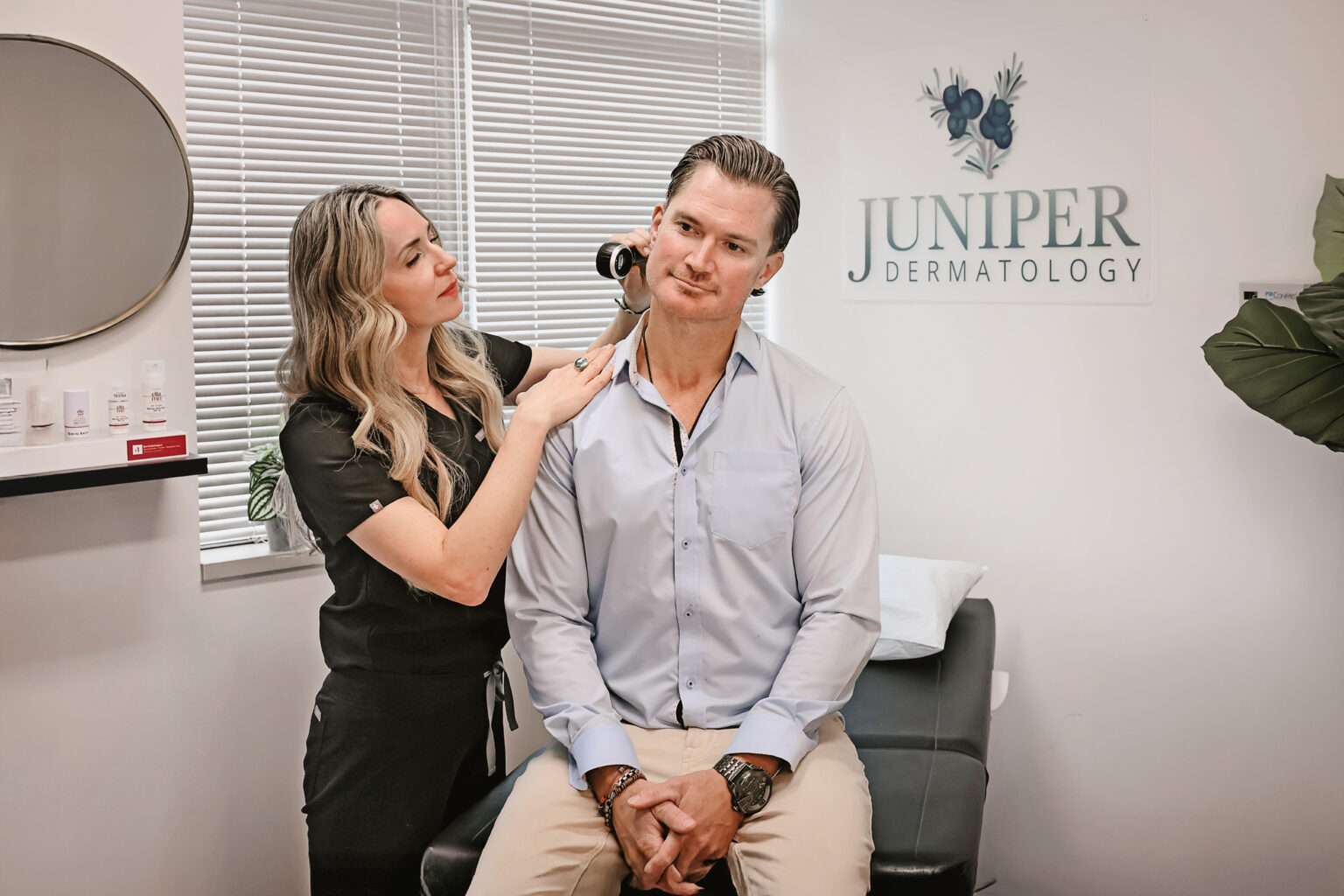
A Juniper provider examines the area with a dermatoscope, reviews your history and sun exposure, and identifies suspicious or precancerous spots.
A small biopsy is taken and sent to pathology so the diagnosis, SCC subtype, and risk features can be confirmed before any treatment decision.
Your plan reflects the report — subtype, size, depth, location, how well-defined the borders are, and whether the area was treated before.
Why choose Juniper
Behind every diagnosis is a person — often a parent, a grandparent, a lifelong Central Oregonian who has spent decades in the sun. We explain your options honestly and help you choose with confidence.
Dermatologist-led decisions. Your options are explained clearly so you can choose the plan that fits your cancer, your skin, and your goals.
Prompt evaluation. Because some SCCs can behave more aggressively, we aim for timely appointments to evaluate a changing spot.
Local, coordinated care. Skin checks, biopsy, pathology-guided planning, and surgical excision are offered in Bend and Redmond.
Insurance accepted. We accept Medicare and most major plans; our team can help verify benefits before treatment. Coverage varies by plan.
Questions & answers
Most squamous cell carcinomas are caught early and treated successfully. SCC can behave more aggressively than basal cell carcinoma in some patients, and in a minority of cases it can spread, so prompt diagnosis and risk-based treatment matter. Your dermatologist assesses the specific risk features of your cancer.
A dermatologist examines the spot, often with a dermatoscope, and confirms the diagnosis with a skin biopsy. The sample is sent to pathology to confirm the diagnosis, the SCC subtype, and features that affect risk, which then guide the treatment plan.
Common options include surgical excision and GentleCure® Image-Guided SRT in Bend for selected cancers. Mohs surgery is coming soon and is not yet bookable at Juniper. Your dermatologist recommends the approach based on pathology, the cancer's size, location, and risk, and your health and preferences.
For selected squamous cell cancers, GentleCure® Image-Guided SRT is a non-surgical option delivered at our Bend office. Whether it is appropriate depends on your pathology, the tumor, its location, and your overall health — a dermatologist makes that determination. It is not used for melanoma.
Mohs surgery is coming soon to Juniper and is not yet bookable here. When a cancer may be best suited to Mohs, we will discuss the options with you. Currently we offer skin checks, biopsy, pathology-guided planning, and surgical excision in Bend and Redmond.
Juniper is a team practice. Depending on availability and your appointment type, you may be seen by Dr. Karla Pivik or another qualified Juniper provider. Your evaluation and treatment plan are guided by dermatology expertise.
Because a history of SCC raises the chance of developing another skin cancer, ongoing skin checks are an important part of your plan. Your dermatologist will recommend a follow-up schedule and teach you what to watch for at home.
Independent sources
These independent, authoritative resources can help you learn more about SCC and its treatment.
Bend & Redmond · Central Oregon
Dermatologist-led skin cancer evaluation in Bend and Redmond — with an exact diagnosis before any treatment decision.