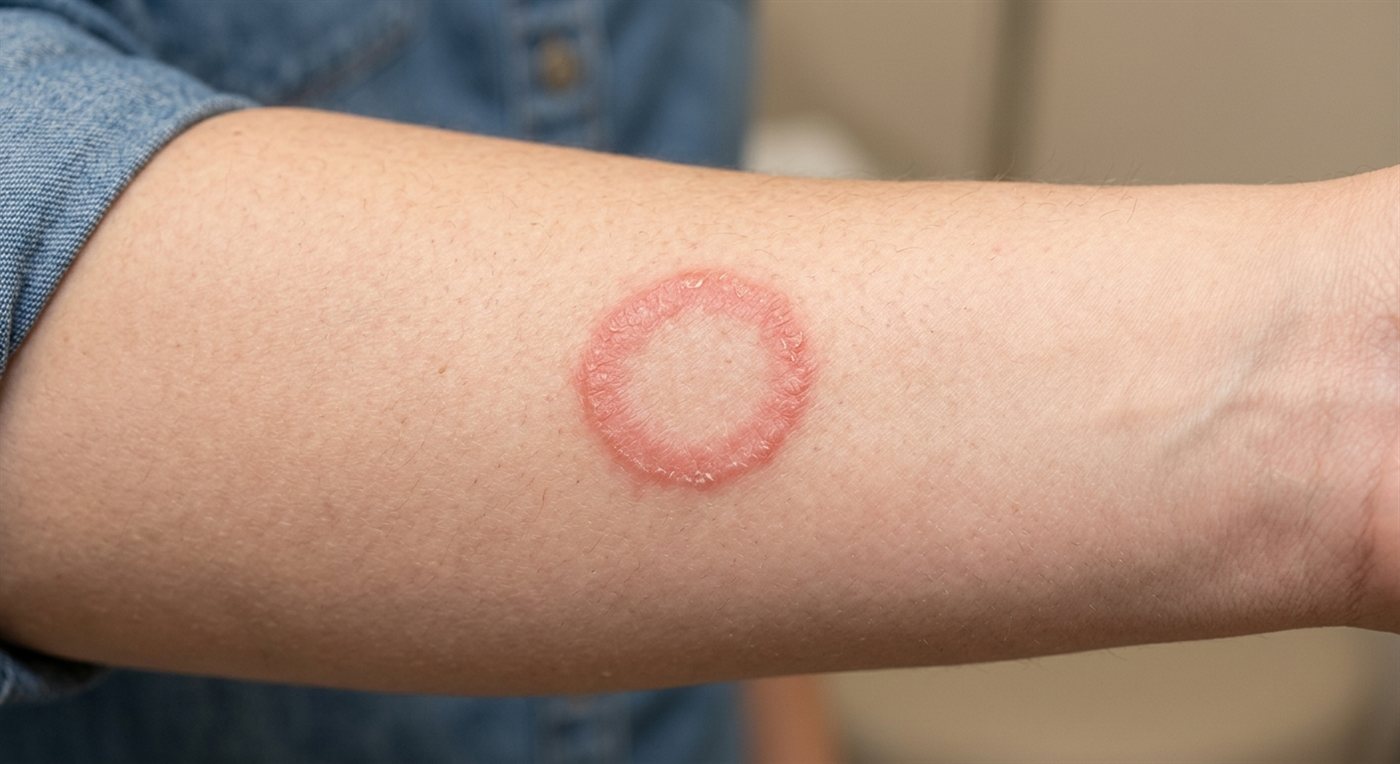
Ring-shaped rash
A patch with a raised, scaly, advancing border and a clearer center - the classic look of ringworm.
Medical Dermatology
An itchy, spreading, ring-shaped rash - or peeling, cracked skin between your toes - is often a fungal infection. Despite the name, ringworm has nothing to do with worms, and the right antifungal clears it.
✓ Medically reviewed by Dr. Karla Snider Pivik, DO, FAAD, FAOCD — board-certified dermatologist

Overview
"Tinea" is the medical name for the common fungal skin infections caused by dermatophytes - fungi that live on the skin, hair, and nails. They go by different names depending on where they land: ringworm (tinea corporis) on the body, athlete's foot (tinea pedis) on the feet, jock itch (tinea cruris) in the groin, and scalp ringworm (tinea capitis) in the hair, which is most common in children. A related yeast causes tinea versicolor, which leaves light or dark patches on the trunk. Despite the name, ringworm involves no worm at all.
These infections are itchy and mildly contagious. They spread through skin-to-skin contact, shared towels, locker-room and pool floors, and even from pets, and they thrive in warm, damp skin - which is why feet, folds, and sweaty areas are favorite spots. Classic ringworm forms a ring with a raised, scaly, advancing border and a clearer center; athlete's foot causes itching, peeling, and cracking between the toes.
Fungal infections are easy to mistake for eczema, psoriasis, or other rashes - and treating them with a steroid cream can actually make them spread and look atypical (so-called "tinea incognito"). That's why confirming it's really fungus matters. A quick in-office test can settle the question, and once we know what we're dealing with, the right antifungal - topical for most cases, oral for scalp, nail, or widespread infections - clears it reliably.
The most common reason a "fungal" rash won't clear is that it was never fungus - or was treated with the wrong cream:
Fungi love warm, damp skin - a few habits make recurrence far less likely:
Signs & symptoms
A patch with a raised, scaly, advancing border and a clearer center - the classic look of ringworm.
Most fungal rashes itch, sometimes with burning or stinging.
Athlete's foot causes itchy peeling, cracking, and sometimes blisters between the toes and on the soles.
Jock itch forms an itchy, red, scaly rash in the groin and inner thighs, often sparing the scrotum.
Fungal patches tend to slowly enlarge outward with a defined, scaly border.
Tinea versicolor leaves light or dark, finely scaly patches on the chest, back, and shoulders.
How we treat it
Treatment starts with confirming it's fungus, then choosing the right antifungal for where it is and how widespread it is. Most cases clear well; the key is treating long enough and drying out the conditions fungi love.
A quick in-office skin scraping (KOH prep) or culture can confirm a dermatophyte before treating - especially if a rash hasn't responded to other creams.
Antifungal creams or solutions clear most cases of ringworm, athlete's foot, and jock itch when used consistently for the full course.
Pills are used for scalp ringworm, nail involvement, widespread or stubborn infections, and cases that don't respond to topicals.
Antifungal washes or creams - and sometimes oral medication - for the discolored trunk patches, with a plan to prevent its frequent return.
If a steroid cream was masking or spreading the infection, we correct course so the antifungal can work.
Practical habits - drying thoroughly, breathable footwear, not sharing towels/shoes - plus treating athlete's foot early so it doesn't reach the nails.
When to come in
Come in if a rash is spreading, keeps coming back, or hasn't cleared with an over-the-counter antifungal - and especially if it's on the scalp, involves the nails, or you're not sure it's really fungus. Scalp ringworm in children and nail involvement need oral treatment, and a rash that isn't fungus needs a different plan entirely. A quick exam and test point you to what actually works.
Schedule with JuniperCommon questions
No - despite the name, there's no worm involved. Ringworm is a fungal infection of the skin caused by dermatophytes, named for the ring-shaped rash it often creates: a raised, scaly border with a clearer center. The same family of fungi causes athlete's foot and jock itch. It's treated with antifungal medication, not anything aimed at parasites.
Yes, mildly. Fungal skin infections spread through direct skin-to-skin contact, shared towels, clothing, and shoes, locker-room and pool floors, and sometimes from pets. To limit spread, don't share personal items, wear sandals in communal showers, wash and dry the area, and start treatment promptly. You can usually go about normal activities while treating it, but covering an active rash is sensible.
The two most common reasons are that it isn't actually fungus - eczema and psoriasis look similar - or that it was treated with a steroid cream, which can make fungus spread and lose its ring ("tinea incognito"). Under-treating (stopping too soon) also lets it return. We confirm it's fungus with a quick test, then match the antifungal to the location and extent so it clears for good.
Most cases respond to a topical antifungal used consistently for the full recommended course, along with keeping the area dry. For stubborn, widespread, or recurring cases - or when the nails are involved - an oral antifungal may be needed. Preventing recurrence matters too: dry thoroughly between the toes and in folds, change sweaty socks and clothing, and wear breathable footwear.
Oral antifungals are used for scalp ringworm (which creams can't reach well), fungal nail infections, and infections that are widespread, stubborn, or unresponsive to topical treatment. Because oral antifungals can interact with other medications and occasionally affect the liver, we choose them carefully and monitor when appropriate - another reason to have a persistent or extensive infection evaluated rather than guessing.
Bend & Redmond · Central Oregon
Board-certified dermatology with same-week appointments — because no one should have to wait for expert care.