Rough, scaly patch
A dry, sandpapery spot you can often feel more easily than you can see it.
Medical Dermatology
Rough, scaly spots on sun-exposed skin are often actinic keratoses - the most common precancer. Treating them early is a simple, effective way to stay ahead of skin cancer.
✓ Medically reviewed by Dr. Karla Snider Pivik, DO, FAAD, FAOCD — board-certified dermatologist
Overview
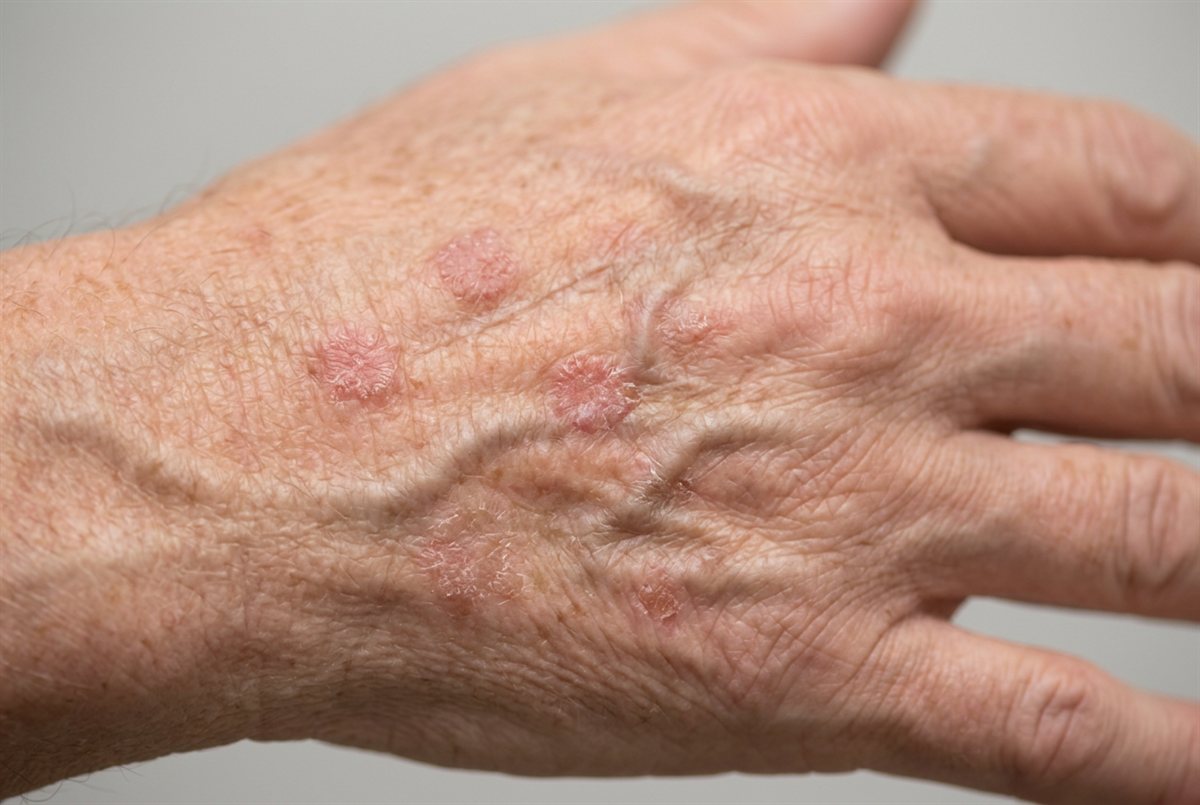
Actinic keratoses (AKs) are dry, rough, scaly patches that form on skin with years of sun exposure - typically the face, scalp, ears, lips, forearms, and the backs of the hands. They're often easier to feel than to see: a persistent sandpapery spot that doesn't smooth out. They can be skin-colored, pink, red, or brown, and there are frequently several at once in sun-damaged areas.
AKs matter because they're considered precancerous. Left untreated, a small percentage can progress to squamous cell carcinoma, a common skin cancer - and because there's no way to predict which ones will, dermatologists treat them proactively. The good news: caught early, they're quick and straightforward to treat, which is exactly why we'd rather address them now than wait.
Here in sunny, high-elevation Central Oregon, sun damage adds up faster than many people expect - UV exposure is stronger at altitude, year-round. If you've noticed rough spots that come and go or never quite heal, it's worth having them checked. We treat the spots you have and help protect the skin around them going forward.
Actinic keratoses are a warning sign worth acting on. Treating them early lets us:
Most AKs respond well to treatment. Tell us right away about a spot that:
Because actinic keratoses are precancers, they connect closely to our Skin Cancer Center and to routine skin cancer screening - and you can read more about skin cancer treatment.
Signs & symptoms
A dry, sandpapery spot you can often feel more easily than you can see it.
Most common on the face, scalp, ears, lips, forearms, and backs of the hands.
Color varies - skin-colored, pink, red, or tan against sun-damaged skin.
May flake off and seem to heal, then return in the same place.
Frequently appears as multiple spots in one sun-damaged area.
Can itch, sting, or feel tender - or cause no sensation at all.
How we treat it
Treatment depends on how many spots you have and where they are. For a spot or two we treat directly; for widespread sun damage, we treat the whole area - and we'll recommend the right approach for you.
Freezing individual actinic keratoses with liquid nitrogen - quick, effective, and the go-to for a limited number of spots.
Prescription creams (such as 5-fluorouracil, imiquimod, or tirbanibulin) that treat both visible AKs and the surrounding sun-damaged skin where new ones form.
A light-activated treatment that clears AKs across a broad area - well suited to the face and scalp with significant sun damage.
Scraping a thick or stubborn spot - and sending it to pathology if there's any concern it's more than an AK.
Because AKs signal sun damage, we keep an eye on the bigger picture with periodic skin cancer screenings.
Practical guidance on sunscreen and sun habits - especially important at Central Oregon's elevation - to slow new AKs from forming.
When to come in
If you have rough, scaly spots on sun-exposed skin that won't smooth out or keep coming back, have them checked - actinic keratoses are easy to treat early and best not left alone. And any spot that grows, bleeds, thickens, or won't heal deserves prompt evaluation.
Schedule with JuniperCommon questions
An actinic keratosis (AK) is a rough, scaly patch that develops on skin damaged by years of sun exposure - commonly the face, scalp, ears, lips, forearms, and backs of the hands. It's considered precancerous, meaning a small percentage can develop into squamous cell carcinoma over time. Because we can't predict which ones will, dermatologists treat them early.
Not yet - they're precancerous. On their own, AKs are not skin cancer, but they're a marker of significant sun damage and a small percentage can progress to squamous cell carcinoma if left untreated. Treating them is a straightforward way to stay ahead of that risk, which is why we take them seriously.
For a few spots, freezing them with cryotherapy (liquid nitrogen) is quick and effective. For widespread sun damage, we use 'field therapy' - prescription creams like 5-fluorouracil, imiquimod, or tirbanibulin - or photodynamic therapy (a light-activated treatment) to clear a broad area at once. Thick or suspicious spots may be scraped and sent to pathology. We'll match the approach to your skin.
Sometimes an AK flakes off and seems to disappear, but it often comes back in the same spot, and new ones tend to form in sun-damaged skin. Because they can slowly progress and are impossible to predict individually, the safest approach is to treat them rather than wait and watch a precancer.
Sun protection is the key - daily broad-spectrum sunscreen, hats, protective clothing, and avoiding peak-intensity sun. This matters especially at Central Oregon's elevation, where UV is stronger year-round. Regular skin checks also help us catch and treat new spots early before they become a problem.
Bend & Redmond · Central Oregon
Board-certified dermatology with same-week appointments — because no one should have to wait for expert care.